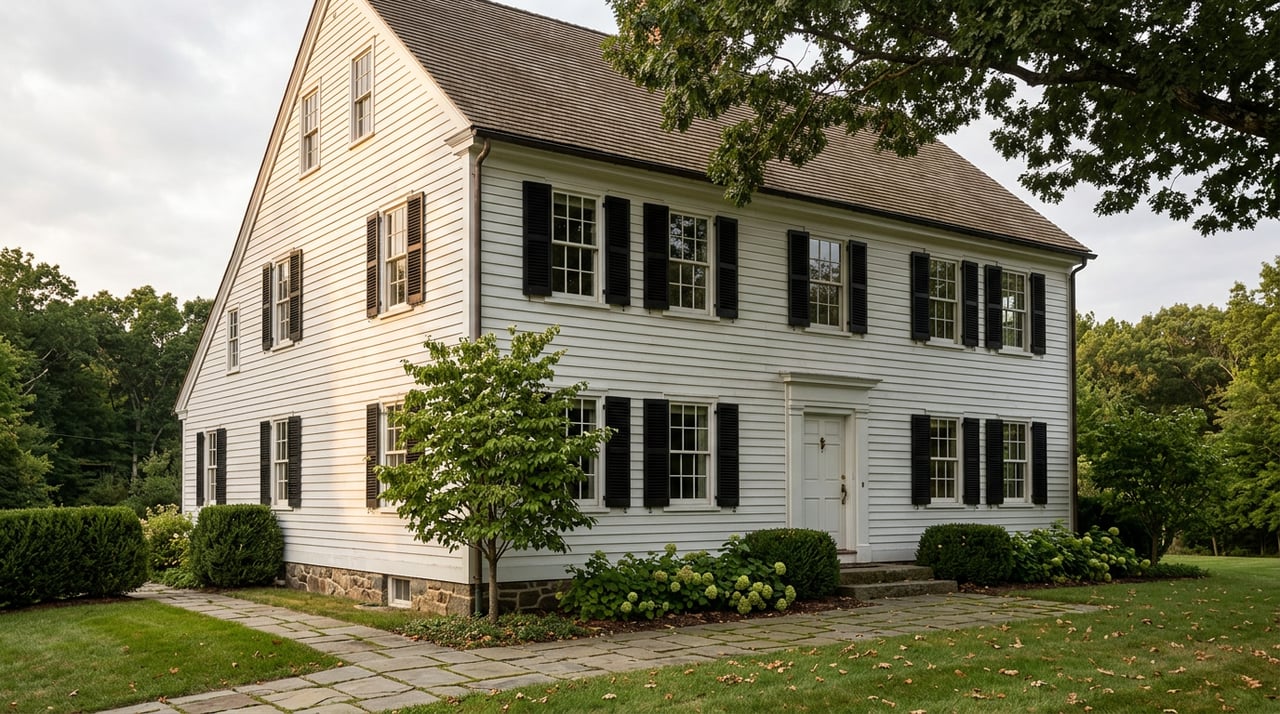
A buyer under contract on a stone farmhouse off Pound Ridge Road pulls the town's historic district map to check whether a planned rear addition will need a hearing. The parcel sits well outside the boundary lines for both Bedford Village and Katonah. No red flag. The buyer proceeds on the assumption that this is an as-of-right renovation, prices the addition into the budget, and sets a closing date around it.
Then the title search or a call to the Building Department turns up something the map never showed: the house is on the town's Tier 1 historic buildings list. A third board, one that has nothing to do with either mapped district, now has jurisdiction over the exterior work. The renovation timeline that was built around a straightforward permit process just picked up a review step nobody budgeted for.
This is the piece of Bedford's real estate mechanics that rarely makes it into a listing sheet, and it matters most to exactly the kind of buyer looking at an older colonial, farmhouse, or early-1900s estate in this part of Westchester: the house doesn't have to sit inside a historic district to be historically regulated.
Two Districts, and a Third Board the Map Doesn't Show
Bedford has two locally designated historic districts you can actually see on a map. The Bedford Village Historic District, established in 1972, covers the hamlet core that dates to the town's founding in 1680, including the Village Green and a colonial graveyard. Its Review Commission has authority within that boundary, and the Bedford Village Historic District Review Commission guidelines say paint colors are expected to stay consistent with the historic scheme, with white preferred and shutters in black or Essex Green.
The Katonah Historic District, added to the National and State Registers in 1983, covers the hamlet that residents still call "the village that moved," since the entire settlement was relocated in the late 1890s to make way for New York City's watershed expansion. Most of its buildings went up or were moved between 1885 and 1910, planned with input from the Katonah Village Improvement Society and landscaping tied to the Olmsted firm. Its Historic District Advisory Commission handles review too, but, according to the Town of Bedford's Katonah Historic District Advisory Commission page, roofs and paint colors are not subject to its review at all.
That difference alone should change how a buyer plans a project. A homeowner in Bedford Village who wants to repaint the trim a different shade is dealing with the district's paint-color guidelines. A homeowner in Katonah doing the identical repaint is not.
Then there's the board that doesn't correspond to either colored area on the map: the Historic Building Preservation Commission, created under Town Code Chapter 71 specifically to cover properties outside the two designated districts that still carry historic or architectural significance. This is where the town's early-20th-century "Hilltopper" mansions, colonial-era farmhouses, and vernacular barns scattered across Bedford Hills, Katonah, and Bedford Village end up.
The List That Isn't on Any District Map
The Town of Bedford's Historic Preservation page says the HBPC sorts properties into three categories: Tier 1, Tier 2, and Unregulated. Only Tier 1 buildings require Commission approval for demolition or what the code calls significant alteration, which the Bedford Town Code defines to include removing or altering historic exterior form, material, or details, or adding an addition that pushes forward of the primary facade's wall plane. According to the Bedford's Historic Building Preservation Law, Tier 2 buildings are treated as-of-right for nearly everything except demolition, which still has to be routed through the Director of Planning for an administrative permit rather than a full commission hearing.
The town's Survey of Historic Buildings, adopted in 2017, is the actual reference document, and it spreads these designations across roads that have nothing to do with either mapped district: the Millers Mill-Middle Patent-Mianus River corridor, listed as one of the town's designated scenic roads, Sunnyfield Farm, a cluster the survey calls the Holly houses, and pockets of Katonah referred to internally as Neighborhood 2 and Neighborhood 5. None of that shows up if you're only checking whether an address falls inside the shaded district lines on the zoning map.
The ordinance itself explains why the town built this third layer. Bedford's own findings cite landmarks like the 1787 Bedford Court House, the John Jay Homestead, and Caramoor as evidence that historically significant structures are scattered through Katonah, Bedford Hills, and Bedford Village alike, not confined to the two mapped cores. A Tier 1 designation is the town's way of extending review to that wider pool without redrawing district boundaries around every individually significant property.
What Five Recent Restorations Actually Show
In November 2025, the Town Board held a recognition event for five historic homeowners, and the list is a useful cross-section of how spread out this regulatory landscape really is. It included 82 Edgemont, built in 1897 and restored by the Crosby and McKendry family; the Old Firehouse, now known as oHHo, at 34 Village Green, built in 1929 and renovated by owner Govind Friedland; the Hoyt House at 48 Parkway, built in 1860 and relocated from Old Katonah in 1897, enhanced by the Kendall family; the Nehemiah Bates Homestead at 47 Pound Ridge Road, built in 1794 and renovated by the Cameron family; and the Armstrong House at 118 Babbitt Road, an early-1900s property renovated by the Cohen family.
The event was presented by Clayton Rose, who chairs the Bedford Village Historic District Review Commission, and Kate Terry, who chairs the Historic Building Preservation Commission. Nearly 100 historic homeowners turned out. That's not a small constituency, and it's evidence that the review apparatus touches a meaningful share of the housing stock a buyer might be evaluating in this price range, not a handful of edge cases.
What the five addresses have in common is spread, not proximity. A 1794 homestead on Pound Ridge Road, a 1929 firehouse on the Village Green, and a 1900s house on Babbitt Road are not clustered inside one boundary line. They represent three different points on the town's historic timeline and, in at least one case, a building that was physically moved decades after it was built. That's the pattern a buyer needs to internalize: age and architectural character are better predictors of review jurisdiction in Bedford than an address's proximity to either historic district's boundary.
What This Means If You're Writing an Offer
For a buyer comparing an older Bedford property against something newer in an adjacent town, the practical takeaway is to check jurisdiction before the renovation budget gets built, not after.
- Confirm whether the address sits inside the Bedford Village or Katonah district boundary using the town's published maps, since that determines which commission and which rulebook applies.
- If it's outside both, check the Tier list from the 2017 Survey of Historic Buildings before assuming the project is unregulated. A property can be well outside both mapped districts and still carry Tier 1 status.
- Understand the clocks are not identical. According to the Bedford Town Code, a certificate of approval application to the Bedford Village Historic District Review Commission is deemed approved if the Commission hasn't ruled within 60 days of filing. A Historic Building Preservation Commission determination on a Tier 1 alteration or demolition application is due within 30 days of the close of a public hearing, a different mechanism with a different trigger.
- If the property is Tier 2, remember that most work is as-of-right, but demolition still requires an administrative permit from the Director of Planning rather than a commission hearing, a smaller hurdle but not a zero hurdle.
- If a listing agent can't answer which commission has jurisdiction, that's a due diligence gap worth closing before a renovation-contingent offer goes in, not after the inspection period expires.
None of this makes a historic Bedford property a worse investment. If anything, the town's willingness to fund three separate volunteer commissions, one purely for buildings outside its own mapped districts, says something about how seriously this market treats the preservation of its older housing stock, which is part of what protects value in these neighborhoods over time. It just means the diligence has to go one layer deeper than checking a single map.
Frequently Asked Questions
Does every older home in Bedford require historic commission approval before renovation? No. Properties inside the Bedford Village or Katonah district boundaries are subject to the applicable district review. Tier 1 properties require Commission approval for demolition or significant alteration; Tier 2 properties are generally as-of-right, with demolition requiring an administrative permit. A home can be old and architecturally distinctive without being inside either district or listed as Tier 1 or Tier 2.
Are paint colors regulated the same way across all of Bedford's historic properties? No. The Bedford Village Historic District Review Commission does review paint colors and has a stated preference for white with black or Essex Green shutters. The Katonah Historic District Advisory Commission explicitly excludes roofs and paint colors from its review.
If my property is Tier 2, do I need approval for a rear addition? Generally no. Tier 2 buildings are treated as-of-right for most work. Demolition is the exception, which still requires an administrative permit from the Director of Planning rather than a full commission hearing.
Where can I check whether a specific address carries a Tier 1 or Tier 2 designation? The Town of Bedford's Historic Building Preservation Commission page publishes the property list drawn from the 2017 Survey of Historic Buildings, along with district maps for both Bedford Village and Katonah.
For buyers weighing a historic Bedford property against newer construction elsewhere in Westchester or Fairfield County, this is exactly the kind of detail that belongs in the decision before the offer, not after. William Martin works this market from the finance-first perspective that high-value, older housing stock demands. Request a private, investment-grade consultation before your next Bedford offer goes in.
This article is general information, not legal, tax or financial advice. Consult a qualified professional about your situation.